



















Handheld laser welding machines are becoming increasingly popular in modern metal fabrication due to their high welding speed, precision, flexibility, and ease of operation. Unlike traditional welding methods such as TIG and MIG, laser welding uses a highly concentrated beam to generate heat directly at the joint, producing strong, clean welds with a relatively small heat-affected zone.
As laser welding technology continues to advance, its applications are expanding across a wide range of industries. From stainless steel kitchen equipment and sheet metal fabrication to automotive components, architectural metalwork, and industrial machinery, handheld laser welders offer a flexible solution for joining different types of metal components.
So, which industries use handheld laser welding machines, and what are their main applications? In this article, we’ll explore the most common laser welding applications and explain how this technology can help manufacturers improve welding quality, productivity, and production efficiency.
What Is a Handheld Laser Welding Machine?
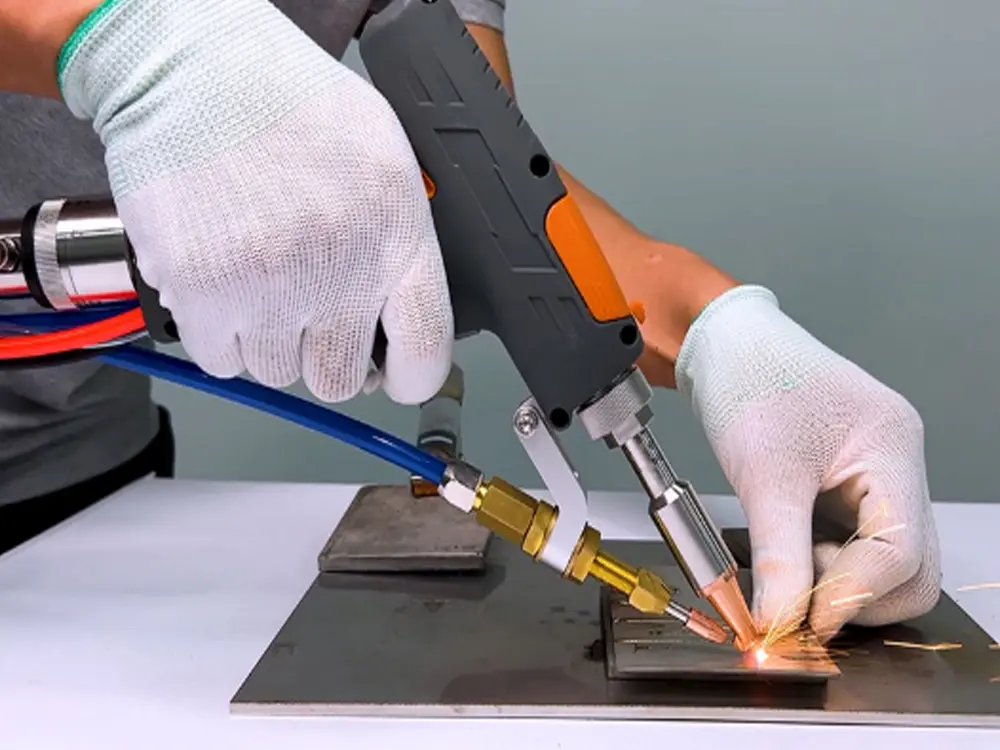
A handheld laser welding machine is a fiber laser system designed for manual metal joining. It uses a focused laser beam to generate concentrated heat at the welding joint, while the operator guides the handheld welding gun along the seam. This enables precise and controlled welding of different metal components with reduced heat input and a relatively small heat-affected zone.
The concentrated laser beam produces a relatively small heat-affected zone compared with many conventional welding methods. This helps minimize thermal distortion and makes handheld laser welding suitable for applications that require clean weld seams, accurate joints, and efficient production.
Depending on the laser power, welding head, and process parameters, handheld laser welding machines can process a wide range of metals, including stainless steel, carbon steel, aluminum, brass, and other common metal alloys. The appropriate laser power should be selected according to the material type, thickness, joint design, and required welding performance.
Another advantage is the potential to reduce weld spatter and post-weld finishing. With properly selected welding parameters, laser welding can produce smooth and consistent seams, reducing the need for extensive grinding and polishing. This makes handheld laser welders suitable for applications ranging from custom fabrication and small-batch production to general industrial manufacturing.
In welchen Branchen kommen tragbare Laserschweißgeräte zum Einsatz?
1. Metal Fabrication and Sheet Metal Industry
Metal fabrication is one of the most common areas for handheld laser welding. Fabrication shops often work with sheet metal, frames, cabinets, brackets, enclosures, pipes, and custom components in different shapes and sizes.
The flexibility of a handheld welding gun allows operators to access different joints and welding positions without relying on a fixed automated system. This is especially useful for customized products, prototypes, and small- to medium-batch production.
2. Stainless Steel Kitchen Equipment
Stainless steel kitchen equipment is another important area for laser welding applications. Manufacturers produce sinks, countertops, cabinets, shelves, worktables, containers, and food-processing equipment that require both strong joints and a clean surface appearance.
For visible stainless steel products, weld finishing can have a significant impact on production time. Laser welding can produce relatively narrow and consistent seams, potentially reducing grinding and polishing requirements while helping achieve a cleaner finished surface.
3. Automotive and Auto Parts Manufacturing
Automotive and auto parts manufacturing involves a variety of metal components, including brackets, panels, frames, exhaust parts, and other assemblies. Handgehaltene Laserschweißgeräte can be used for selected components, particularly in repair, customization, prototyping, and small-batch production.
Their flexible operation allows manufacturers to work with different component designs without setting up a dedicated welding system for every part. This can be useful for businesses handling customized automotive components or lower-volume production.
4. Doors, Windows, Railings, and Architectural Metalwork
Architectural metalwork includes stainless steel doors, windows, railings, stair components, partitions, decorative structures, and architectural frames. These products often combine structural requirements with visible metal surfaces where the quality of the finished joint matters.
A handheld welding gun allows operators to work around different shapes and joint locations. For suitable applications, laser welding can also reduce the amount of post-weld finishing required, which is particularly useful for decorative and high-end metalwork.
5. HVAC and Refrigeration Equipment
HVAC and refrigeration manufacturers work with metal housings, tubing, heat exchanger components, condenser parts, and other assemblies. Common materials include stainless steel, aluminum, and copper, depending on the equipment and component.
Handheld laser welders can be used for selected joints where operators need flexible access to different components. The controlled welding process can also be useful for parts where excessive heat may affect surrounding areas or dimensional accuracy.
6. Electrical Equipment and Enclosures
Electrical equipment manufacturers produce control cabinets, distribution boxes, panels, equipment housings, and protective enclosures in different sizes and configurations. These products require accurate assembly while maintaining the overall shape and dimensions of the enclosure.
For manufacturers producing customized cabinets or frequently changing product designs, handheld laser welding provides a flexible alternative to dedicated welding setups. Operators can adjust their working position according to the size and structure of each enclosure.
7. Metal Furniture and Consumer Products
Metal furniture and consumer products include tables, chairs, shelving systems, cabinets, frames, and decorative products made from stainless steel, carbon steel, aluminum, and other metals. Product designs can vary considerably, especially for customized furniture and interior products.
The flexibility of handheld laser welding makes it suitable for this type of production, allowing operators to work with different components and product designs without relying on a fixed welding line. This is particularly useful for customized orders and small production runs.
8. General Manufacturing and Machinery
General manufacturing covers a broad range of products, including machine frames, equipment housings, brackets, covers, and mechanical components. The size, structure, and welding requirements of these parts can vary significantly from one product to another.
Handheld laser welding does not have to replace conventional welding throughout the entire production process. Manufacturers can select the appropriate process for each component, using laser welding for precision joints or thin metal components while retaining conventional methods for heavier structural work.
9. Aerospace and Precision Metal Manufacturing
Aerospace and precision metal manufacturing require careful control of material properties, dimensions, and welding processes. While automated and specialized systems are more common for highly controlled aerospace production, handheld laser welding may be considered for selected applications such as prototyping, maintenance, repair, and certain thin metal components.
For these applications, manufacturers need to pay close attention to welding parameters, material preparation, shielding gas, operator training, and applicable quality requirements. Handheld laser welding should therefore be evaluated according to the specific component and required production standards.
10. Custom Fabrication, Maintenance, and Repair
Custom fabrication, maintenance, and repair work often involve irregular components, changing job requirements, and workpieces that are difficult to process with fixed equipment. Applications can range from equipment repair and metal restoration to customized parts and prototype work.
The mobility of a handheld welding gun allows operators to move between different workpieces and adjust their position according to the joint. This makes handheld laser welding practical for workshops that handle varied jobs rather than standardized, high-volume production.
Why Are Handheld Laser Welding Machines Used in So Many Industries?

The wide range of laser welding applications is not based on a single advantage. Instead, handheld laser welding combines processing efficiency, operator flexibility, material compatibility, and relatively simple production requirements, allowing it to adapt to different manufacturing environments.
1. Faster Welding and Higher Productivity
For suitable metal materials and thicknesses, laser welding can provide high welding speeds compared with some conventional processes. This can help manufacturers shorten processing time and increase overall production efficiency, especially when a large number of similar joints need to be completed.
2. More Controlled Heat Distribution
A focused laser beam concentrates energy into a small welding area. This gives manufacturers greater control over heat input and can help limit unnecessary heating of surrounding material. For applications involving thin sheet metal or components with tight dimensional requirements, this level of heat control can be particularly valuable.
3. Less Post-Weld Processing
The welding process can produce relatively narrow and consistent seams when the machine is correctly configured. As a result, some applications may require less grinding, polishing, or other finishing work after welding. This can help reduce secondary processing and shorten the overall production cycle.
4. Greater Access to Different Workpieces
Unlike fixed welding equipment, a handheld welding gun can be positioned around different parts of a workpiece. Operators can adjust their working position according to the shape and location of the joint, making the equipment suitable for products with complex geometries or changing designs.
5. Compatibility with Common Industrial Metals
Fiber laser welding technology can be applied to many commonly used metals, including stainless steel, carbon steel, aluminum, copper, and brass. By adjusting laser power, wire feeding, shielding gas, and other process parameters, manufacturers can configure the welding process for different materials and thicknesses.
6. One Machine for Multiple Applications
Another reason for the widespread adoption of handheld laser welding is its multifunctionality. A 4-in-1 handheld laser welding machine integrates welding, laser cleaning, laser cutting, and weld seam cleaning into one system. This allows manufacturers to handle multiple metal processing tasks with fewer machines, saving workshop space and improving operational flexibility.
How to Choose a Handheld Laser Welding Machine for Your Industry?
Start by identifying your actual production needs. Consider the types of products you manufacture, the size and shape of your workpieces, the frequency of product changes, and the welding positions operators commonly encounter. A workshop focused on customized fabrication may have very different requirements from a manufacturer producing standardized components in larger quantities.
Your working environment is another important factor. Consider the available workshop space, power supply, ventilation, cooling requirements, and how easily the equipment can be positioned around different work areas. A compact and flexible system can be particularly useful for workshops where production layouts change frequently or space is limited.
It is also important to evaluate the machine configuration as a whole rather than focusing on one specification. Consider the laser source, welding head, wire feeder, cooling system, control system, and other core components. A well-matched configuration can contribute to stable operation and make it easier for operators to maintain consistent welding results.
Ease of operation should also be considered, especially for businesses introducing laser welding into an existing production process. An intuitive control interface, straightforward parameter adjustment, and practical operator training can help shorten the learning curve and make daily operation more efficient.
For businesses that perform different metal processing tasks, machine functionality can also influence the purchasing decision. A 4-in-1 system that combines welding, laser cleaning, laser cutting, and weld seam cleaning can provide greater flexibility when multiple processes are required within the same workshop.
Finally, evaluate the supplier as carefully as the machine itself. Manufacturing experience, quality control, technical documentation, spare parts availability, warranty terms, operator training, and after-sales support can all affect long-term equipment performance. For international buyers, responsive communication and reliable remote technical support are especially important when selecting a laser equipment supplier.
Schlussfolgerung
Handheld laser welding machines can be used across a wide range of metalworking tasks, but the right configuration depends on the specific production requirements. The growing range of laser welding applications makes it important to evaluate the equipment based on the actual workpieces, workflow, and operating conditions.
Before making a purchase, manufacturers should consider the machine configuration, workshop environment, ease of operation, required functions, and supplier support. For businesses handling different metal processing tasks, a 4-in-1 system can also provide additional flexibility within one machine.
WINTEK Laser offers handheld laser welding machines in different power configurations for various industrial applications. Contact us with your material, thickness, and production requirements to get a suitable solution.
