











As fiber laser cutting technology continues to mature, machines are being pushed to run faster, more accurately, and for longer continuous production cycles. What was once considered high-end performance has now become the industry baseline.
During the purchasing process, however, most buyers still focus on visible specifications. Laser power, maximum cutting thickness, and automation level usually take priority. These parameters are easy to compare and straightforward to understand. Meanwhile, one critical feature that is often overlooked is the anti-collision protection built into the cutting head.
This leads to a common but important question: Do fiber laser cutting heads actually need anti-collision protection? The answer is yes. And the reasons go far beyond basic safety concerns.
In real production environments, anti-collision systems play a critical role in protecting precision components inside the cutting head. They help maintain consistent cutting performance. More importantly, they reduce unexpected downtime and repair costs. This is especially true for modern laser cut machine for metal operations.
Why Is Anti-Collision Protection so Crucial in Real Production
In real production environments, laser cutting machines do not operate under ideal laboratory conditions. Sheets are not always perfectly flat. Materials vary from batch to batch. Machines run at high speed, often unattended, for extended periods.
Under these conditions, anti-collision systems play a critical role. They protect the precision components inside the cutting head, help maintain consistent cutting performance, and most importantly, reduce unexpected downtime and repair costs.
For modern laser cutting operations, especially those focused on metal fabrication, stability and continuity are just as important as cutting speed. A single collision can stop production, damage expensive components, and disrupt delivery schedules. Anti-collision protection is designed to minimize exactly these risks.
Which Cutting Head Brands Offer Anti-Collision Protection
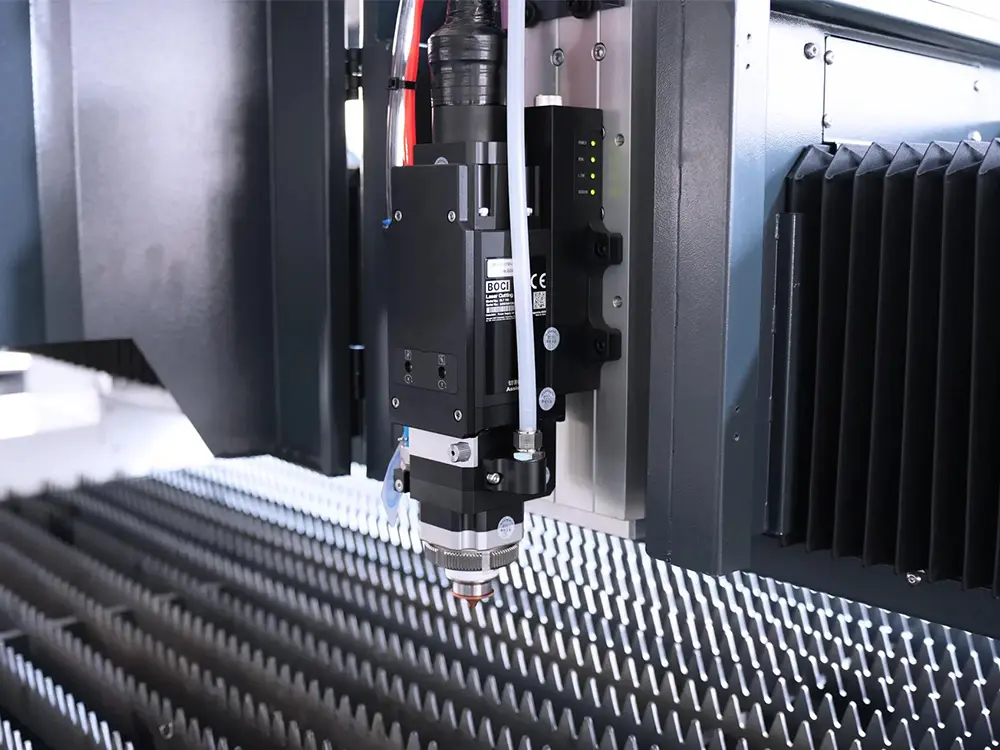
Some laser cutting head brands provide anti-collision protection as an optional feature. Among these brands, only Boci cutting heads support this functionality. Boci cutting heads typically have a more robust mechanical structure and advanced sensor systems, which can better handle high-speed or high-power cutting, making their anti-collision protection more practical and stable in complex working scenarios. The choice between these heads depends on production requirements. Factors such as material type, sheet thickness, cutting speed, and the complexity of nested parts all affect the importance of anti-collision protection.
Boci’s higher-end design can provide extra stability in demanding operations, fully exerting the advantages of anti-collision protection to adapt to various harsh cutting conditions.
Configuring anti-collision protection on Boci cutting heads also allows manufacturers to maintain cutting accuracy under high-speed operation. By limiting the force transmitted to the head during unexpected contact, the system prevents misalignment of lenses and nozzles, reduces the risk of uneven cuts, and ensures consistent edge quality. This makes production more predictable and helps maintain output quality even in long or automated shifts.
What Is Anti-Collision Protection in a Fiber Laser Cutting Head
Anti-collision protection is a mechanical or sensor-based safety mechanism integrated into the laser cutting head. Its primary purpose is to protect the cutting head when unexpected obstacles are encountered during operation.
These obstacles may include:
- Warped or uneven metal sheets.
- Upturned edges after cutting.
- Slag buildup or residual material.
- Operator setup errors.
- Sudden height control failures.
When the cutting head encounters such obstacles, the anti-collision mechanism allows part of the head to deflect, disconnect, or retract instead of absorbing the full impact. This prevents direct damage to sensitive components such as lenses, nozzles, and internal sensors. In high-speed cutting environments, where the cutting head operates extremely close to the material surface, this protection becomes increasingly important.
Why Collisions Occur More Often Than Expected
Many users assume that collisions are rare events caused mainly by operator mistakes. In reality, collisions can occur even in well-managed, automated production environments.
1. Material Deformation During Cutting: Heat input during cutting can cause thin sheets or long parts to warp slightly. Even small deformations can be enough for the cutting head to make contact at high speed.
2. Residual Parts Not Fully Detached: When parts are not completely separated from the sheet, they may tilt upward unexpectedly, especially during fast nesting operations.
3. Height Control Lag: Capacitive height sensors are highly accurate, but no system responds instantly. At high cutting speeds, even a brief delay can lead to contact.
4. Inconsistent Material Thickness: Mixed or lower-quality sheet batches often vary in thickness, increasing the likelihood of unexpected collisions.
As cutting speeds and automation levels continue to increase, the overall risk profile of laser cutting machines also rises, making passive safety features such as anti-collision protection more relevant than ever.
Is Anti-Collision Protection Necessary for All Applications

While anti-collision protection is highly recommended, its importance varies depending on how the machine is used.
It is essential for:
- High-speed cutting of thin sheets.
- Automated or unmanned production.
- Complex nesting with small or delicate parts.
- High-power laser cutting (6000W and above)
- Production environments running long shifts.
In these scenarios, anti-collision protection is not a luxury. It is a safeguard for production continuity and equipment reliability.
Anti-Collision Protection and High-Power Laser Cutting
As laser power increases, so does the kinetic energy involved in machine motion. High-power cutting heads are typically heavier and more complex, making them more vulnerable to impact damage.
Additionally, high-power cutting often involves:
- Thicker plates
- More slag generation
- Greater thermal distortion
These factors increase collision risks. That is why most manufacturers consider anti-collision protection a standard feature on high-power laser cut machine for metal systems rather than an optional add-on.
Does Anti-Collision Protection Affect Cutting Accuracy?
A common concern among buyers is whether anti-collision mechanisms reduce rigidity or precision.
In practice, well-designed anti-collision systems:
- Maintain rigid positioning during normal operation.
- Only activate under abnormal force conditions.
- Do not interfere with height sensing or focus control.
Modern designs ensure that accuracy is preserved while still providing protection. When properly calibrated, the cutting performance of a laser cut machine for metal remains stable and repeatable.
Anti-Collision Protection vs Operator Skill
Experienced operators can reduce collision risks through proper setup and monitoring. However, relying solely on human skill has limitations.
Fatigue, shift changes, and production pressure all increase the chance of error. Anti-collision protection acts as a safety net. It does not replace operator skill, but it provides backup when conditions are less than ideal.
For factories aiming for consistent output rather than operator-dependent performance, this feature becomes increasingly important.
Conclusion
Anti-collision protection provides an essential layer of safety for fiber laser cutting heads, reducing the risk of damage to sensitive components and minimizing unplanned downtime.
On Wintek fiber laser cutting heads, this feature ensures reliable performance even in high-speed, high-power, or complex production environments, without compromising cutting precision. By enhancing operational stability and extending component life, anti-collision protection helps workshops of any size maintain consistent production and achieve long-term equipment reliability.