



















Fiber laser metal marking is a cutting-edge technology that offers unmatched precision, speed, and durability for marking metals and certain non-metal materials. Whether you are manufacturing automotive components, electronic devices, tools, or industrial equipment, fiber laser marking has become the go-to solution for permanent, high-quality markings.
In this article, we’ll explore what fiber laser metal marking is, how it works, advantages, common applications, and essential considerations when choosing a fiber laser marking machine.
What Is Fiber Laser Metal Marking?

Fiber laser metal marking is a non-contact process that uses a high-powered, focused beam of light to create permanent marks on the surface of metal objects. The laser beam is generated by a fiber laser source and delivered through a flexible fiber-optic cable to the marking head.
Unlike traditional marking techniques such as engraving, stamping, or chemical etching, fiber laser marking does not require physical contact or consumables. Instead, it relies on intense, controlled light energy to alter the material’s surface in a highly localized manner.
Wintek fiber laser marking machines meet current market quality standards and are widely applicable for marking various types of metals. Such as:
- Carbon steel
- Stainless steel
- Aluminum
- Brass
- Copper
- Titanium
- Gold and silver
- Nickel alloys
How Does Fiber Laser Marking Work?
The core of the fiber laser marking machine process lies in its ability to generate a focused laser beam with high energy density and direct it onto a small area of the metal surface. The process is non-contact, fast, and extremely precise.
Here’s how it works step by step:
Laser Generation:
The system uses a fiber laser source (usually 20W–100W), which emits a concentrated beam of light with a wavelength around 1064 nm, ideal for marking metals.
Beam Delivery:
The laser beam is transmitted through fiber-optic cables and directed by high-speed galvanometer mirrors (Galvo head) that control the movement and position of the beam.
Focusing:
The lens focuses the laser beam onto a small spot on the material’s surface, achieving high energy density.
Material Interaction:
The intense laser energy interacts with the material’s surface.
Software Control:
Marking content—such as serial numbers, barcodes, logos, or text—is designed using specialized software (eg: EZCAD) and precisely controlled for repeatable, high-quality results.
Fiber Laser Marking Machine Components
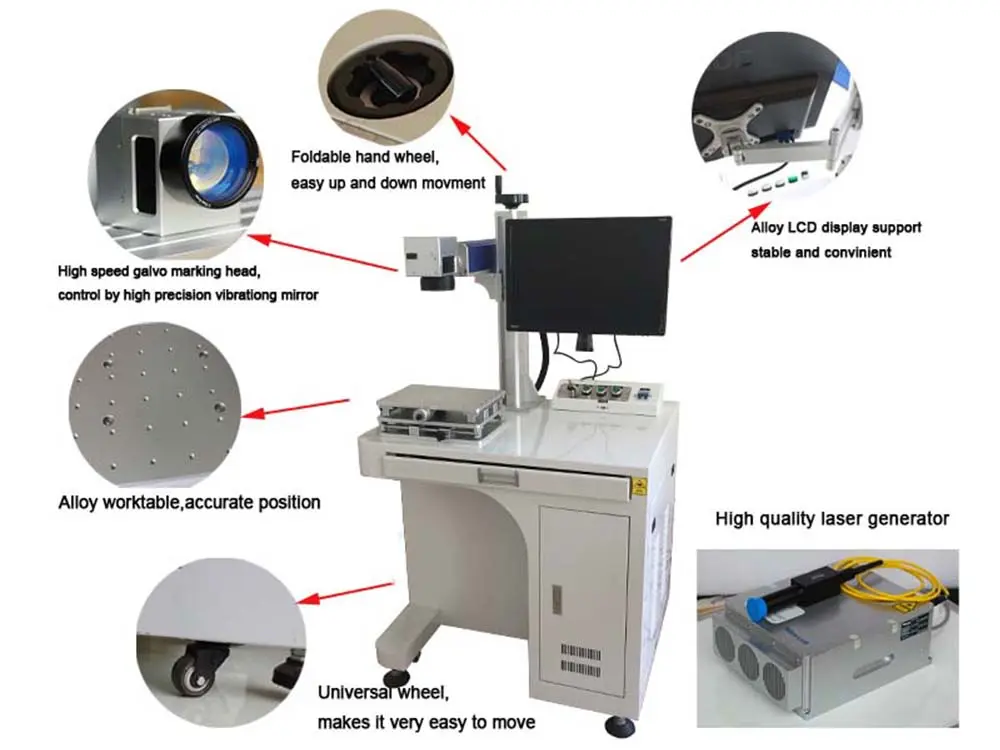
Fiber Laser Source: The main energy generator (often 20W to 100W), such as a Raycus, JPT, or IPG laser.
Galvo Scanning Head: Controls the precise movement of the laser beam at high speed.
F-Theta Lens: Focuses the laser beam onto a flat marking area.
Control Software: Used to design and manage marking patterns, barcodes, QR codes, serial numbers, logos, and text.
Worktable or Platform: Supports the workpiece and may include auto-height adjustment or rotary fixtures for cylindrical items.
Fiber Laser Metal Marking Machine Advantages
Fiber laser technology offers several major advantages over traditional and other laser marking methods:
Permanent and High-Contrast Marks
Laser markings are resistant to wear, heat, corrosion, and chemicals — ideal for industrial environments.
Non-Contact and Precise
The laser beam does not touch the material, which eliminates tool wear and ensures precision even on delicate parts.
Fast Processing Speeds
Galvo-based fiber lasers can mark at extremely high speeds — often over 5000 mm/s — making them suitable for mass production.
Low Maintenance and Long Service Life
Fiber lasers have no moving parts in the laser source and typically offer 100,000 hours of working life.
Compatible With Automation
Easily integrated into production lines for automated marking and part tracking.
Common Applications of Fiber Laser Metal Marking
Fiber laser metal marking is widely used in various industries due to its versatility:
- Automotive: For marking VIN numbers, component codes, and identification labels on metal parts.
- Aerospace: Used to ensure part traceability and apply critical safety markings on components.
- Electronics: Ideal for marking printed circuit boards (PCBs) and micro-electronic components.
- Jewelry & Gifts: Enables custom engravings on precious metals like gold and silver.
- Tools & Hardware: Applied for branding, size markings, and serial number identification.
- Industrial Parts: Suitable for applying logos, QR codes, and batch numbers for product tracking and quality control.
Types of Marks You Can Create
With the right software and settings, fiber laser marking machines can create:
- Alphanumeric characters
- Barcodes and QR codes
- Serial and batch numbers
- Logos and symbols
- DataMatrix codes
- High-resolution graphics
These markings are clear, detailed, and readable by both humans and machines.
Factors to Consider When Choosing a Fiber Laser Metal Marker
When selecting a fiber laser metal marking machine for your business, keep the following in mind:
Laser Power
Higher wattage (30W–100W) allows for deeper engraving and faster speeds. For basic marking, 20W may be sufficient.
Marking Area
Common sizes include 110×110 mm, 175×175 mm, and 300×300 mm. Larger areas offer flexibility but may reduce precision.
Cooling Method
Most fiber laser markers are air-cooled, which is simpler and more energy-efficient than water-cooled systems.
Software Compatibility
Choose a system compatible with common design files (DXF, AI, PLT, BMP) and capable of variable data marking.
Workpiece Compatibility
Consider whether you need rotary attachments for cylindrical parts or a height-adjustable Z-axis.
Conclusion
Fiber laser metal marking is a highly effective solution for industries that require permanent, precise, and reliable markings on metal components. Its non-contact nature, speed, and low operational costs make it a smart investment for both small workshops and large-scale manufacturers.
Whether you’re marking logos on stainless steel tools, serial numbers on aluminum parts, or data codes on titanium implants, a fiber laser marking machine delivers the quality and efficiency modern production demands.
If you’re interested in learning more about which fiber laser marking machine fits your needs, or want to request a quote, feel free to contact our team at Wintek — we’re here to help you find the best solution.
